Tuesday, July 17, 2012
Star Trek '12: 2312 AD - Humans
Marty Pressman was an engineer in Starfleet. He’d worked on starship design theory for a couple of years before he became frustrated with the fundamental flaw of the program, and that was the moratorium on cloaking devices.
Everyone knew that the Federation had signed a treaty with the Romulan Empire forbidding it, but Pressman didn’t particularly care. He knew what he wanted and didn’t like to be told he couldn’t have it. So instead of conforming to expectations, he started to rebel. He spent late hours pouring over documents about the treaty, its specifics, exact wording, history, alternate theories…His superiors started asking him questions, even though he was careful, and it was only a matter of works before he was called to speak with the captain, and during this little chat he was informed that the Romulans had learned about his activities, and Starfleet was not at all happy about that. At the very least, he was told, he should have cleared this interest with his immediate supervisor, if not the chief, if not the captain himself.
Pressman asked if he could speak freely. The captain allowed it. Pressman hesitated for a moment, and then decided that he might as well seize the opportunity. He started by asking if the Romulans really had a right, or if the Federation had a right, to make such judgments. Was the price of peace really at the cost of progress? Was it not Starfleet mandate to expand the horizon, rather than diminish it?
He started to feel a little giddy. The captain said nothing, so he continued. Surely there were secret programs, some agency or another, who were already working on it, or perhaps there were officers who had already cracked the code, or other species who would share the secret. Romulans couldn’t be the only ones who possessed the technology. In fact, he suggested, there must be several, if not hundreds, members of the Federation. There were similar methods he knew of that Starfleet did allow. Would it really be such a stretch to expand them, to work around the treaty?
He began to grow more bold. The captain remained silent. He continued. Was peace with an empire that had now been silent for decades really worth the cost to the future? Was not the foundation of the Federation built on the exchange of ideas, rather than stifling them? Had not humanity itself struggled with Vulcans over this very issue for more than a century?
The captain finally spoke. He said that Pressman was a valued member of his crew, with a promising career. He would make many valuable contributions to the fleet, no doubt. Except in this area. It was vital that he put this behind him, and that he do it then and there. Surely he must understand the need for security, the need for compromise? Many individuals had looked into these matters before him. The Federation had not signed the treaty lightly, but with great cost of life, and with utmost integrity. Surely that was worth preserving?
Pressman knew when he was dismissed. He saw the bored expression in the captain’s eyes. He waited to be dismissed, and watched as the captain reviewed a data pad. Finally, there was a slight nod, and Pressman stepped out of the ready room, and onto the bridge of the ship, where the helm officer, a friend of his, smiled weakly at him. He continued to the turbo shaft, passing the science station, and thought glumly about what the captain had just told him, in so many words that he should mind his own business. He stepped into the lift and gave the command for engineering. He stood quietly for a moment, the doors opened again, and he walked into the busy hub of activity that did not hold anything for him, not now.
He knew he would not be promoted. He thought of his young son Erik, attending primary school on Rigel IV. If he stopped now, the boy would not be affected by these decisions, might still have a chance at a better career than him, perhaps be able to fulfill this mad dream.
Pressman continued in a haze for the remainder of the day, doing his job mechanically, which was the only way he’d survive from now on, no longer believing in anything, hoping for another war with the Romulans, or that the Klingons would do it, or that some miracle would happen and the universe would suddenly start making sense. He started making private notes of everything he’d seen.


Friday, July 13, 2012
Star Trek '12: 2212 AD - Horta
Orczy is not much of a mining technician, but even he can tell when something is going wrong, specifically that there seems to be a lot more mining going on than be strictly accounted for in the budding operation here on Janus VI.
Orczy is a budding journalist, although he struggles to report anything that others might consider to be news. For instance, rather than cover the mining scandal (so far as he sees it) these last few weeks, he’s been submitting articles on excessive perspiration, another problem he’s noticed, but is a problem only for Orczy, as he has been trying to get his hair just right and all this perspiration has been hindering him. He feels it is to do with the planet and its faulty terraforming, and although he had to go through a laborious process to get this position in the first place, he has been complaining about it almost from the start.
For instance, he wrote his first article about the indecent levels of humidity in the air, and this was rejected on the grounds that there was nothing to be done about it. He submitted a few more on the same topic, in case the first and then the next several had been lost. Then he switched tacks and decided to try some different perspectives. That’s the sort of thing journalists should do, Orczy knows. They should also have nice hair, or so he thinks. He has trouble convincing others of this.
He’s also having a hard time getting anyone to believe that there are a great deal more tunnels beneath the surface of Janus VI than there should be, possibly because he is more eccentric than a Breen hairdresser (it is a noted rumor that all Breen are in fact bald). He talks about this with the rate of someone trying for a record, although he has made no progress at all in getting anyone to listen. He suspects that it is because of the excess moisture in the air. It makes everyone crazy, except Orczy. He maintains razor-like focus, even when his hair isn’t doing what it’s supposed to, which is most of the time. Back on Earth he let everyone know that he had the best hair in the galaxy. It was suggested more than once that perhaps he ought to get out there and prove it.
Orczy wanders about doing nothing much at all most of the day, and that may also affect his reputation somewhat, aside from his criticisms of sweating too much, writing articles of utter nonsense, going on about his hair, and reporting that there are too many tunnels beneath the surface. More than one person has suggested he make an inventory of all the tunnels, and preliminary surveys of Janus VI before the mining operating even began already suggest there to be thousands. Finding an exact number could take some time, but few people can be found to complain about the lack of Orczy that would result from such an effort. No doubt he could be lost for decades!
You might be asking yourself if Orczy has any friends, and Orczy would have one answer that would in many ways contradict reality, but it is also worth noting that he is rarely wrong in his observations; it’s just that he’s exceptionally annoying about it. He mainly signed up for the mining operation because Blakeney would be going, an old friend of his who has the best hair Orczy has ever known, and perhaps his obsession with her can best be described as a form of jealousy. It should be noted that “friend” would be exaggerating a bit, and perhaps even “acquaintance,” as their relationship has chiefly revolved his increasingly failed attempts to get a friendly word out of her. Mainly, it’s Orczy going on about how much he loves her, and Blakeney restraining herself from punching him.
So that’s as much of the social aspect of Orczy’s life as you’ll need. You should probably know upfront that he isn’t wrong about the number of tunnels, but it won’t be for several more decades until anyone knows what the hell he’s talking about.
Monday, July 9, 2012
Monorama now available!
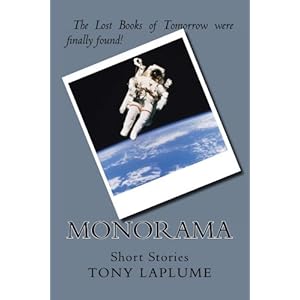
Now, because a lot of people consider themselves to be writers, it's probably harder now than ever before to see your work in print, especially if you don't network well or you don't write in a mainstream style. That fact and the fact that it's become easier than ever before to self-publish has led a lot of writers who would otherwise have found it difficult to fulfill that ambition to do it on their own terms. This necessarily limits distribution to levels professional publishers will only take notice of with uncommon success, so it's a game of vanity, and something I've been reluctant to come back to after my Cloak of Shrouded Men experience, when I paid to get a book printed and got nothing but the book in return.
Now, I don't have a problem writing books. I've got two unpublished manuscripts and another sitting at Hall Bros. Entertainment. It's getting publishers interested that's the problem. I self-published Shrouded Men in 2007 because I had a hard time believing that I'd find any traditional publisher interested in a story about superheroes. At that time, it was the only long-form fiction I'd written. Between 2009 and last year, I wrote three more books. I had attempted to write a complete novella, which became "Leopold's Concentration" as featured in Monorama, in the spring of 2005, before I'd finished what became Shrouded Men in 2006, but my concentration wasn't strong enough. I had already been writing Star Trek fiction since 1999, and that's something I still do today, but that continued to be the best extent of my writing experience, until I launched Sigild last year.
I intended it to be a showcase for my experimental writing, and only started branching back into more ambitious projects many months later. Last fall I nearly published the existing material through Amazon's CreateSpace service, which allows writers who feel up to handling all the publishing decisions on their own to be published completely for free. I bailed when it seemed like too much work. I kept writing, however, and the more material I amassed, the more confident I began to feel, and finally I turned back to the site with a collection I was more confident about, pulling a lot of work together that I hadn't previously considered including besides all the material I myself owned from Sigild.
Naming the collection proved more difficult than I originally anticipated. The original name can still be easily be found on Sigild, but I quickly came up with alternatives, and would have gone with one of those if I hadn't stumbled on the word "panorama" while pulling this collection together, modifying it to reflect the singular perspectives that inhabit each of the stories in the book, even in the ones with multiple characters. It sounded a lot like Futurama, but different enough that I doubt anyone will readily make the connection upon reading the title Monorama, which is a title that works on so many levels, not the least on an ironic one, because this is a book of seven distinct parts.
I decided, ultimately, that I had to make this collection available for the same reasons I launched Sigild in the first place, as a way to get my writing available, to help illustrate in digestible pieces my inclinations as a storyteller. It serves, in essence, as a primer for everything else I want to say, but can easily be enjoyed for its own sake. I didn't write any of these stories with the intention of including them in a collection. Several of them, actually, were submissions to Hall Bros. anthologies, with "Lost Convoy" the first of the longer works I tackled as proof to myself that I don't need to write a novel in order to write something longer than a few pages (most of the stories featured in the "Lost Books of Tomorrow" mosaic are, in fact, about a page each, and some of them aren't even that).
I can't really give you any more of an idea about what to expect in this other than what you can find on Sigild itself, because these are stories meant to be understood best by being read. You can't talk about writing like this without analyzing it, because the style is the same weight as the intent, which is to dig deeply into narrative potential. You'll meet a lot of singular voices in Monorama, like I said. You may not understand what that means until you start reading.
You can find it available for 10 bucks at Amazon in paperback form. You can get it for three bucks as a Kindle edition.
Tuesday, July 3, 2012
Star Trek '12: 2112 AD - Kal Dano
Risa is the greatest planet in the galaxy!
Ahem. If that is not sober enough a statement for you, let me clarify: it’s the only planet where any alien species can find something that pleases it, provided that they find leisure activities pleasing. There were some efforts early on in its existence to provide interests outside of leisure pursuits, but there were too many complications, and thus the concept was abandoned.
Unfortunately, Kal Dano did not get the memo. He believed that it was still a fine destination for things like ultimate weapons, which is the only way the Tox Uthat can be classified. It is indeed an ultimate weapon, a doomsday device so incredible in its destructive ability that Dano was forced to find a new home for it, since its original one proved, as Risa had for things other than leisure activities, completely unfit. Or perhaps Dano was simply a thief looking to stash his goods away for a moment. Perhaps we may know for certain in time.
Which one of our attendants came across Mr. Dano first is still a matter of dispute, but there was a great amount of excitement. He announced himself to be a time traveler, which is not unheard of on Risa, but we tend to regulate our guests so that they do not bring things like ultimate weapons along with them. At any rate, it was explained to him several times that possessing such a thing was inappropriate, and that he would have to dispose of it. Naturally he was not accommodating to our suggestion, and soon gave a wild chase to many members of the staff. Later versions of this will no doubt allow anyone who may learn of it to assume that he simply appeared, dropped off the Tox Uthat, and departed again, but rest assured that while we are by definition lax in most standards, we take security quite seriously, as it’s our basic responsibility to our guests, and we have quite a few gadgets left over from our aborted experiment to be able to provide all levels of security for them. Less responsible hosts might consider a business partnership with the Orion Syndicate, but that’s not the policy or the interest of the governing council on Risa.
But yeah, we could do quite a few interesting things if we liked. We would have confiscated the Tox Uthat if we’d wanted. It was entirely within our rights, and we’d hardly want unsuspecting guests to stumble onto something like that. It would certainly ruin someone’s vacation! As it is, our agents eventually caught up to Mr. Dano and we came to a mutual agreement. While we no longer condone the presence of such things as a matter of course, we are not unreasonable. We wouldn’t be very good at our jobs if we were! Instead, we made sure that only those truly committed to it might discover the Tox Uthat, something Dano himself seemed perfectly satisfied with, as he himself had the ability to monitor it to a greater degree than we could, being privy to the historical records as he is, from whichever century he’s from and happens to linger. It was suggested by our chief of tranquility that he might be an agent of the Temporal Cold War, but most of us dismissed the notion. But you never know.
Actually, I don’t know why I’m going on about all this. Some of us are far more excited at the prospect of humans finally reaching our humble planet. They’re been traveling the galaxy for a good number of years now, but they’re incredibly limited in their propulsion systems at the moment, though rumor has it they’re close to a breakthrough, as long as the Vulcans leave them alone long enough, or maybe if the Klingons finally pay them a visit, if they’re worth it. I have a wager going that the term “Starfleet” won’t amount to much, but then, someone said Kal Dano mentioned it, so what do I know?
Anyway, I’m sure none of this interests you. Care for a horga’hn?
Monday, July 2, 2012
Excerpt from Ecce Homo
The novel Ecce Homo deals with the biblical first family as individuals with unique perspectives on the human condition and its peculiar relationship with the divine, both as they deal with their own seismic contributions to history and as they struggle out into a world where the rest of us have no idea what they've been through. So you get Adam, Eve, Abel, and yes, Cain:
When I was being born, I could feel everything, and could see. My eyes kept opening, but it was all new, and I didn’t know what I was experiencing, so very little made sense. I would see flashes, but nothing made sense. I can imagine what my father was feeling, what he was thinking. He didn’t know what to make of me, only that whatever was happening, must somehow be natural. He didn’t know what I would be like, only what he knew about himself. I wouldn’t say I blame him or my mother for any of what would happen, or even God, because living is a living hell, it’s a constant series of misadventures. Everything that can go wrong will. What we get to call living is a series of opportunities to figure out how to make things right. We either do that or we die. Well, we die anyway, and that’s another terrible tragedy. For some reason, I was fixated on death from the very beginning. I could never explain why. It was always on my mind. I wouldn’t call it morbid or macabre, so much as an innocent fascination.
I could tell right away that my parents never considered it the same way I did, that for them, it was a little more remote concept, that for them, living and dying were two very different ideas. They knew a lot about living, but very little about dying. They had never been born, so naturally they had no idea what kind of experience that is, and so just as naturally, they couldn’t conceive of its opposite. They were created into a world where all living beings were already there. My mother, or so it was constantly told to me by my mother, seemed to have an instinct about how it all worked, but that was different from an understanding. She never had to think about it. She was part of the first and last generation of mankind that was designed to function perfectly. She had the most direct divine spark possible, next to my father, who was the first man ever created, given all the most personal attentions of the one being responsible for everything. In genetic breeding, it’s encouraged not to introduce too much familial intermingling, just as the clone of a clone is that much less stable, just as a master can never teach a student everything they personally have mastered. There’s a constant degeneration, something lost with every new iteration. Either something else comes along, a new source of inspiration, or a spontaneous knowledge, or progressively, everything gets worse. It’s nature, the way it’s set up, nothing is ever lost, but everything is always changing, either in patterns or in new designs, and when it’s difficult to tell what’s going on, it produces a sensation of fear, because the unknown is always a source of fear. Imagine a world where the patterns aren’t known, imagine a world where everything’s new. My parents knew God, interacted with him personally. They never talked about it, but then, they didn’t have to. It was just something I knew, perhaps my portion of the divine spark, an unspeakable knowledge, an unbearable burden. I was the first person born, rather than created. Something lingered inside me. I knew death.
I saw the world with a fresh set of eyes; I was born with an appetite, and I was always hungry. That was how I came to understand death, because knowledge is the ability to understand things, to know how they work. The first thing knowledge breeds is the awareness of the existence of death, because anything that works eventually stops working, moves on in other permutations. The reason most people believe the things they knew in their youth were better than the things they experience in their advancing age is because they are clinging to the hope that things don’t die, and therefore, they themselves won’t. It’s foolish and not very intelligent, but that’s human nature. It believes what it wants to, whatever is most comforting. If it’s easier to believe in something you’ve already believed in, rather than tackling something new, then that’s what you’re going to, despite all reason. If it’s easier to believe something new, because others have before you, then you will, not because you believe but because you’ve allowed yourself to believe in someone else’s belief. You’ve latched onto something that already exists, something else old, established, something that seems permanent. To accept something new, of your own accord, is to once again accept that new things are possible, and new things suggest a beginning, and in the beginning an end. That’s how the mind works, because that’s how existence works. Death is feared because it provides the opportunity to answer the ultimate riddle, in how it’s possible for nothing to exist at all. In the existence of nothing, isn’t nothing itself something?
I thought too much. I knew that. I was thinking before I could talk, obviously, but even when my parents encouraged speech, I still kept thinking. I think some people substitute one for the other, perhaps without even realizing it. It sounds dumb to suggest one or the other, but not both at the same time, but it seems to be the only explanation for how some people behave. Anyone who can’t explain what they’re doing is probably missing one. They react more than anything, attempt to reconstruct something they’ve seen but can’t understand. Anyone who will just imitate or follow something they’ve seen or have been told, they have already made a decision, and that was the last thought they will ever have.
My life was a series of decisions, and an endless line of thought. I determined that the only way for me to truly live was to consider the possibilities, even before I was conscious of the fact of my unique nature, that I was the first person ever born. I was aware of it, certainly, but I didn’t understand it, couldn’t quite appreciate it, at least not right away. I was reacting, however, to the fact before I knew it, and that was the distinction, what all the thought was about. My father might say, as he often whispered into my ear in my first years, that I reminded him of my mother, how reflective and solitary I was, even before I could do anything about it. That’s how he could understand it, what a baby was like for him, the only way he could reconcile it with what he already knew. I developed a concept of my mother before I even knew her, and that’s as much as I ever had. I don’t mean to suggest that she was remote, only that she could only be who she was, and she was very much as my father suggested, someone like me, but who wasn’t me. I had to understand the world in terms I knew, too, in what I might recognize, and that was in contrasts, in what was like me, and what wasn’t. My father was always there. My mother wasn’t.
As I came to understand it later, she didn’t stay like that, the more children she had. She was far more involved with Abel. I didn’t resent that, as strange as it sounds, given what happened. It was evidently something she needed. I had already proved that she didn’t need to behave that way, but she chose to, and that’s all that really mattered. Life is a series of choices, and there’s rarely a lack of second chances. The more you live, the more you accept that. You can’t relive and make different decisions than you’ve already made, but there will always be other opportunities. There is only one permanent, and that’s death, and that was true from the very start, before birth. The act of creation demanded it. There’s an opposite to everything.
I guess I began to view Abel as my opposite. That’s probably what it was. I recognized a lot of the things he did, because I’d done them, too, but I also realized that he wasn’t me, any more than I could be him. I wasn’t that old when he was born, but I was able to make some concrete distinctions. His existence made a lot of things easier to understand. It might be easy to assume that all Abel did was frustrate me, but that wasn’t the case at all. Abel made things easier. His existence clarified many of the things I’d been thinking. My brother was a confirmation.
Excerpt from Finnegan
Here's an excerpt from Finnegan, a funny little story about vampires, history, and the weird ways family and strangers can intermingle in fantastic and frightening ways. The following only suggests about a tenth of what is actually in the novel, but it's a good look into the thought and depth of the characters and the vastly complicated situation they find themselves in:
Actually, it’s completely different. On some level, such relationships, such real dilemmas, must be how those romantic comedies were once conceived. A situation like Romeo and Juliet, who would have been happy together except their families were blood enemies, that might have been a possible source, or another successor. This isn’t to say that it’s unnatural for a vampire and a mortal human to fall in love, because love is blindness, but that it’s a basic contradiction. Unless the vampire makes their lover into a vampire, they are dooming themselves into unhappy, temporary lover. You can make an argument that eventually, one of the two could come to find some peace in the arrangement as it is originally introduced, but even in that, it will become to the vampire, in time, as if it never really happened. Long life already undergoes enough change. The purpose of intimacy is to retard it, as much as possible.
Since it is hardly likely that most people would introduce themselves with their least savory characteristics, it’s natural to assume that this will almost always be a problem. A vampire meeting a human will never come right out and say that they are a vampire, which at the offset complicates everything. Since humans and their thoughts are inherently private matters, thought is almost always kept private, and as a result, privacy is held as one of the most valued traits we possess, the thing that serves as the barrier and obstacle across the entire world, which in almost every case remains standing throughout the lifetime. This is where secrets, deception, and betrayal come from. It is from the privacy of thoughts that evil arises, the belief that no one can truly understand or accept each other, so that perhaps it doesn’t matter, you can tell yourself anything, and you will almost never be contradicted.
Were there to be a vampire culture, mastery of the privacy instinct might be considered the primary goal of the community. If there were free and open relations between vampire and humans, lines of perfect transparency might be the first ones to be fostered. Being a vampire would be no different from hailing from a certain country, speaking a certain language, or practicing a certain religion. In its essence, vampirism is really no different from these things. It is, only a distinction; it is “different” only in the way that all people are different in some way.
Except vampires are solitary creatures, and they remain legend at best to the common human experience, a fiction. Their origins are hardly known at all. Did God say, let there be vampires? Are they descended from angels, perhaps, or demons? Eolake might have found an easy piece of conversation on these lines, making the transition in his relationship with Fiona. It was something he had to tell her, because being a vampire is not something that she would have noticed herself. What was there that would have given him away? He looked no different, behaved no differently. To all intents and purposes, he was human, like the athlete who isn’t tell, gaunt, or muscled, who when they aren’t engaged in their sport, look no different from anyone else. The vampire is not pale, their hairline is ordinary, and they do not shrink from blood, or sunlight. They dress like anyone else. They simply have different biological characteristics.
In the beginning, it didn’t matter. Eolake was a vampire, but Fiona wouldn’t have cared. She fell in love with the Eolake she was presented with. He was charming. He was polite. He was, in the chivalric tradition, a gentleman who presented a comforting, loving persona right from the start. He seemed like he loved all mankind, and Fiona was lucky enough to be there and win his affections on a more intimate level. In time, she noticed things that put chinks in his armor, but she was okay with them. She wasn’t interested in those things. She was interested in Eolake.
At the point he began wondering if he should tell her, she wouldn’t have cared. She had grown used to his presence, and if he had told her that he was a sofa, she would have gladly placed him in her living room and told her cat to not leave too much fur on him. Real love was that Eolake was allergic to the cat, but was willing to take medication so that it was not a problem. If there was medication for taking away the vampire, Eolake would gladly have taken that, too.
Star Trek '12: 2012 AD - Nacene
Eight hundred years earlier things were a little simpler.
Well, that would be the myth. Except, sometimes, we know better. Sometimes we’re able to see the past with clarity, without rose-tinted blinders, and we know that things were no better then than they are now, and maybe that’s why some people are always depressed, why they can’t find any positive meaning in their lives.
Well, the Caretaker, as such he had begun to consider himself, and would consider himself for another three hundred years, until his death, knew better. Suspiria was finally leaving him. It wasn’t anything that had happened recently, or had been developing for several hundred years, or even the incident that had brought them to this predicament in the first place. It simply happened. Most things that happen are exactly like that, actually. There’s no reason. You can certainly learn a lot about what happened before it if you look, but that doesn’t mean it had anything, in the end, with what just occurred. Every moment in time is precious and alone and of itself.
There’s no reason to look deeper, to forge connections, to map everything as if it all had a single thread running through it. There are patterns, is all, and perhaps it’s wise to know what they are, but if there’s a meaning, then that’s a matter of interpretation, not fact.
The fact was, Suspiria wanted to try something new. All the Ocampa who left with her did. In fact, they wanted to return to old ways, just as she did. The problem neither of them realized was that they were leaving essential elements of what would have helped make that possible behind. None of the Ocampa who departed could truly understand or appreciate what their ancestors had once had, because they were leaving the last remnants of context behind. They would be starting over, believing that they were reviving old practices and old abilities, when in fact they were creating new ones. Suspiria was not in the least interested in helping them grow. For her, they were a matter of convenience, just as she was for them. The same was true, of course, for her. She had never known a life on her own, and yet there she would be, on her own, without her companion for the first time in her life. The relationship she had with her chosen Ocampa was nothing like the one her companion had with the rest of them.
The Caretaker knew that. He understood what would happen to her, even if he mourned both these losses for a very long time, and why he knew with a certainty that she would outlive him, and why he gradually forgot what that would mean, why he had known why she left, why he would forget that it only made sense, that they were no longer as similar as they had once been, why they had drifted apart, why so many things had and would continue to change.
He tried to put it past him, the heartbreak, the useless feeling gnawing at the pit of his stomach, the uncertainty about the future, but found that he was unable. He had a purpose, and perhaps had already lost himself in it, and perhaps would remember one day that the only true path to the future was remembering to regain himself, if only for a moment, so that all his work, his triumphs and failures, would mean something again, that his efforts would not be in vain, and he could once again tell himself that he hadn’t caused more harm than good.
Perhaps he could find a new companion, a replacement, someone to lighten the load, who would understand him better, and perhaps they were far away and perhaps they were close. He had to try…
Subscribe to:
Posts (Atom)